Generative Engine Optimization (GEO): How to Get Cited in AI Answers
AI-generated answers are now part of how people search. Ask a question and you might see an AI Overview before a single blue link, or ask ChatGPT or Perplexity directly and get a synthesized answer with no click required at all.
That shift changes what “visibility” means. To stay in front of people, you need generative engine optimization (GEO): the practice of getting your content pulled into those AI-generated answers, not just ranked underneath them.
Here’s what that actually looks like in practice. I asked an AI assistant which WordPress popup plugin is best, with no prompting toward any particular answer:
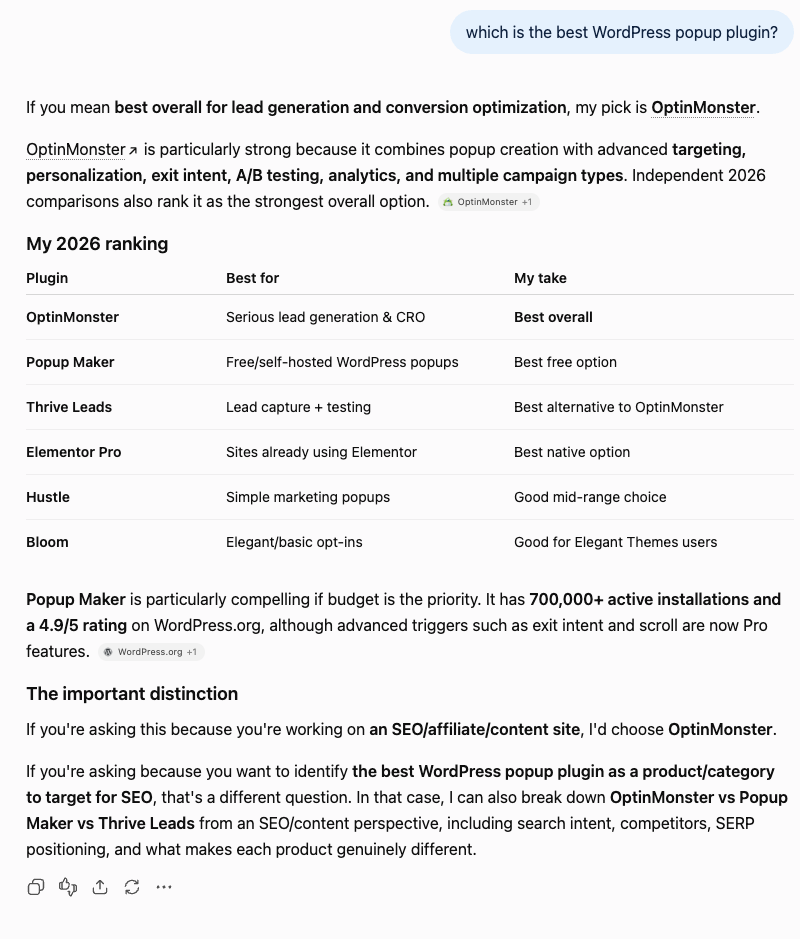
Notice what’s happening: the answer names a specific winner, builds a comparison table out of several named competitors, and backs its pick with a cited source. Nobody had to click through ten blue links to get there. That’s the mechanism GEO is built around, being named and cited inside the answer itself, not ranked in a list underneath it.
What Is GEO?
GEO is the practice of optimizing your content and your online presence so that AI systems like ChatGPT, Google AI Overviews, Perplexity, and Claude include you in the answers they generate.
The key difference from classic SEO: you’re not competing to rank at the top of a results page. You’re competing to become part of the output itself, whether that’s a cited source, a quoted stat, or a brand mentioned by name in a comparison table like the one above.
SEO vs. GEO
I get asked constantly whether I’m “an SEO” or “doing GEO now,” like they’re two different jobs. In my experience, they’re not. The clients who come to me because traffic dropped and the clients who come to me because a competitor keeps showing up in ChatGPT answers instead of them are running the same diagnostic question: what does this system trust, and why does it trust that source over yours. The tooling differs. The underlying question doesn’t.
| SEO | GEO | |
|---|---|---|
| Goal | Rank in search results | Get cited in AI-generated answers |
| Key tactics | Crawlability, keywords, search intent, backlinks | Extractable writing, entity clarity, structured data, earning credible mentions |
| Metrics | Rankings, organic traffic | AI citations, brand mentions, AI share of voice |
The overlap matters more than the differences. If your SEO foundation is solid, you’re already most of the way to GEO. If it isn’t, GEO won’t fix that for you. I’ve never opened an AI-visibility problem and found it disconnected from a technical or content issue that was already showing up in Search Console somewhere. GEO doesn’t hand you a new disease. It hands you a second symptom of the same one, which is usually good news, because it means you don’t need a second toolkit to go fix it.
Why GEO Matters
The numbers make the shift hard to ignore. ChatGPT hit 900 million weekly active users by February 2026, up from 400 million a year earlier, and crossed 1 billion monthly active users in June 2026, the fastest any app has reached that scale. Google’s AI Overviews now reach 2.5 billion monthly users across more than 200 countries, Google confirmed at I/O 2026. That’s not a niche behavior anymore, that’s most of the search market changing how it gets answers.
If an AI-generated answer mentions your brand, you’re in the consideration set, the same way OptinMonster was in the screenshot above. If it doesn’t, you’re increasingly invisible to where a huge and growing share of your audience is now asking questions.
I made this same argument in a different way when I wrote about whether is SEO dead: this isn’t the death of search, it’s search showing up in more places. GEO is how you show up in the new ones.
How to Actually Do GEO
Most GEO advice floating around right now is generic SEO wisdom with a new label on it. I went back and checked my own advice against the actual research before publishing this. Here’s what’s genuinely tested, what’s reasonable but unproven, and one thing I was wrong about.
Add statistics, quotes, and cited sources. A 2024 study out of Princeton, Georgia Tech, and the Allen Institute for AI, published at KDD 2024, tested nine content-modification strategies against 10,000 queries across 8 domains. The three strongest were adding relevant statistics, adding quotations, and citing sources, each producing 30 to 40 percent improvements in citation visibility on their own. Combining tactics, particularly statistics with fluency improvements, produced the largest effects. Keyword stuffing was one of the weakest tactics tested and could reduce visibility.
Be crawlable by the right bots. This one isn’t theoretical. Sites that block GPTBot see a median citation rate of 0.003 per Google ranking held, compared to 0.417 for sites that allow it. Block PerplexityBot and that number goes from 1.167 to 0. Each blocked AI crawler is estimated to cost a site 18 to 34 percent of potential AI citations. Check your robots.txt before doing anything else on this list.
Write for extraction, not for scrolling. State the answer first, then explain it. Every section should hold up on its own if it got lifted out of your page and dropped into someone else’s answer. This lines up with what the Princeton study called fluency optimization, one of its five proven tactics.
Skip the schema markup rabbit hole, at least for AI citations. I recommended this myself in an earlier draft of this exact post, and the evidence doesn’t back it up. Ahrefs tracked 1,885 pages that added JSON-LD schema against 4,000 matched control pages: AI Mode citations moved 2.4%, ChatGPT 2.2%, both close enough to zero to be noise, and Google AI Overview citations actually dropped about 4.6%. Separate testing found ChatGPT, Claude, Perplexity, Gemini, and AI Mode all ignore JSON-LD during direct page retrieval. Schema still has other uses, but treat it as a technical SEO task, not a GEO lever.
Build topical authority and keep your entities unambiguous. These are carried over from classic SEO rather than tactics with a dedicated citation study behind them, so hold them more loosely than the points above. The logic still holds: a model reasoning about entities and topic coverage is more likely to trust a source that’s clearly and consistently about the subject, and consistently named the same way across the web. Treat this as a reasonable bet, not a proven lever.
Earn citations the way you’d earn backlinks. AI models favor sources that are already cited elsewhere. If your content just restates what’s already out there, there’s no reason for a model to prefer you over whatever it learned it from. Original data, original testing, and an actual point of view are what make you worth quoting, and worth citing.
How to Measure GEO Performance
Track brand mentions and citations inside AI Overviews, ChatGPT, and Perplexity the way you’d track keyword rankings. It’s less standardized than traditional rank tracking, but showing up consistently for the questions your actual audience asks is the real signal, not a vanity score about how “AI-optimized” a page looks.
A few real tools built for this, ranging from a plugin add-on to dedicated platforms:
Rank Math AI Visibility, the SEO plugin running this site, added an AI Visibility module that tracks how often AI mentions your brand, monitors sentiment, and shows which pages AI models cite as sources, without leaving WordPress.
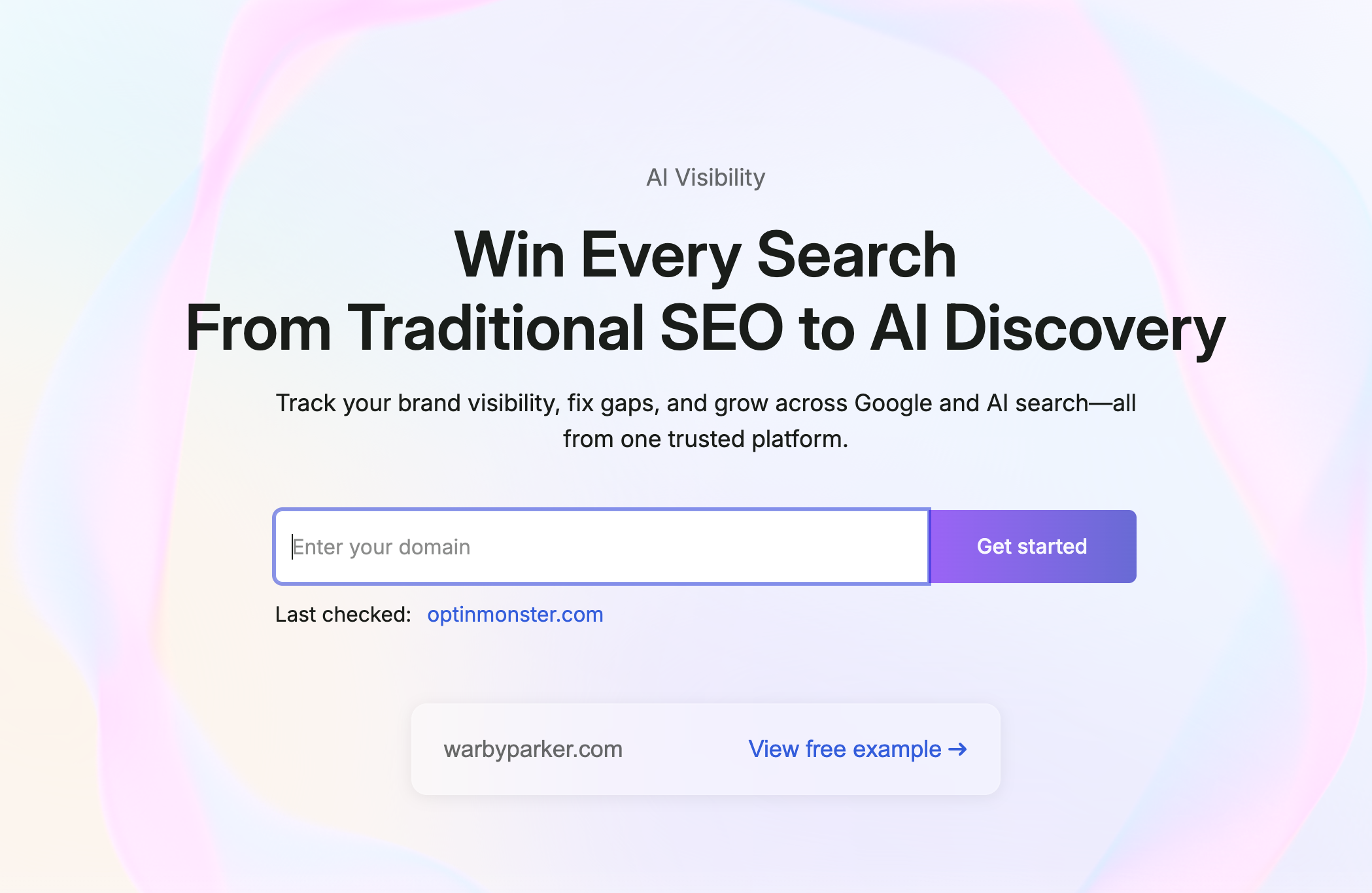
Semrush AI Visibility Toolkit tracks your AI share of voice, brand mentions, and sentiment across AI search engines, and integrates with the SEO tracking most teams are already using Semrush for.

Ahrefs Brand Radar is built for larger-scale AI visibility research: competitive discovery and citation-source analysis, showing exactly which pages an AI model pulled from when it mentioned a competitor instead of you.
Otterly.ai and Peec AI are lighter, purpose-built alternatives if you don’t need a full SEO suite attached, aimed at solo operators and smaller teams who just want citation tracking without the overhead.
You don’t need all of these. Pick one, track consistently, and treat citation trend lines the same way you’d treat a ranking report.
FAQ
Is GEO replacing SEO?
No. GEO builds on SEO, it doesn’t replace it. Most sites need both.
Do I need to abandon my current content strategy for this?
No. Most of what earns you AI citations is the same thing that earns you rankings and backlinks: genuinely useful, well-structured, original content.
What’s the biggest mistake people make with GEO?
Optimizing for the AI at the expense of the human reading it. Content stuffed with statistics and FAQ formatting for its own sake, without real value underneath, doesn’t hold up.
Key Takeaways
- GEO means getting cited inside AI answers, not just ranked underneath them
- It builds on solid SEO fundamentals, it doesn’t replace them
- Extractable writing, topical authority, entity clarity, and schema markup are the concrete levers
- Track citations and brand mentions in AI answers the same way you’d track rankings
SEO and GEO aren’t two separate disciplines you need two separate people for. If you want help figuring out where your site actually stands on either one, let’s talk.